

Last updated: 2026-10-26
A security-monitoring alert. An unusual volume of outgoing email. A ransom note on a server. A message from a processor. A notification from USOM.
Five public breach notices describe five different routes to discovery. For a founder, operations lead or security manager, they raise a practical question: which route would find a breach in your business, and who would act on it?
The comparison supports treating detection as a portfolio of signals. Technical monitoring matters, but so do staff observations and reports from outside the organization. Each route offers a different view, with different limits.
These five notices were listed as published on 21 October 2026. They summarize the organizations’ reports and state that examination was continuing. Publication dates are separate from incident and detection dates. The notices do not establish a common provider, weakness or root cause, and they are not final findings of liability.
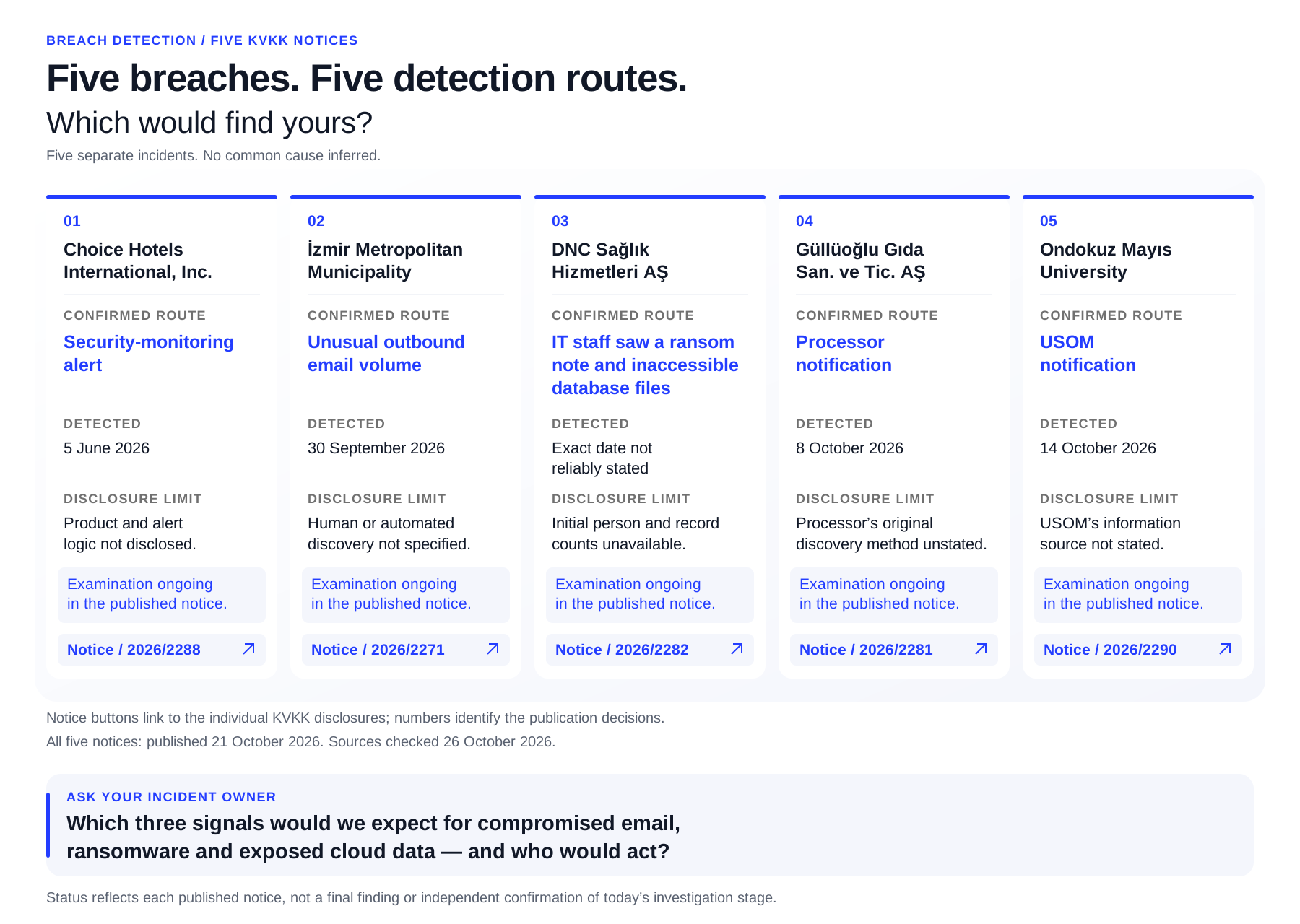
The case facts below come from the individual notices. The operational lessons are recommendations drawn from comparing them, not findings about controls the organizations did or did not have.
Confirmed route: An alert generated by security-monitoring controls.
Reported detection date: 5 June 2026.
Investigation status: Examination ongoing in the published notice.
Choice Hotels International, Inc. reported unauthorized access to an employee’s network account through social engineering. Its monitoring controls generated the alert through which the breach was detected.
The notice places both the start and detection on 5 June, with the incident ending on 6 June. It does not identify the monitoring product, alert logic or exact detection time.
What this route can reveal: Monitored activity that matches an alert condition and warrants investigation.
What it cannot establish alone: The complete scope of access, all affected data or whether every relevant system is covered. Same-day detection also does not establish immediate containment.
For your business, ask for a recent test showing that a relevant alert reached someone able to investigate it.
Confirmed route: Detection of an unusually high volume of email sent from a corporate account.
Reported detection date: 30 September 2026.
Investigation status: Examination ongoing; the affected-person count was not fully determined.
The municipality reported access using a previously compromised password. The notice distinguishes this from exploitation of an email-server vulnerability.
Reported findings included mailbox contents from two accounts being transferred outside the organization, deletion rules, bulk spam and fraudulent signature text. The notice does not say whether an automated control or a person first identified the unusual volume.
What this route can reveal: A change in how an account is being used.
What it can miss: Activity that does not generate a sending spike. A mailbox check should also consider suspicious forwarding, deletion rules and altered account settings.
For your business, “we would notice lots of spam” is a starting point. Ask what would expose quieter misuse.
Confirmed route: IT staff saw a ransom note on the server screen and found that database files were inaccessible.
Reported detection date: The displayed notice does not provide a complete, unambiguous date.
Investigation status: Examination ongoing; exact person and record counts could not initially be determined.
DNC Sağlık Hizmetleri AŞ reported encryption affecting a server containing personal data, including health information. Encryption also obstructed the initial assessment of how many people and records were affected.
What this route can reveal: A visible incident requiring urgent technical investigation and operational decisions.
What it cannot establish alone: When access began, how the attacker entered or whether information was copied before encryption. Inaccessible files are not proof that data stayed inside the organization.
For your business, make staff reporting easy, while testing earlier signals such as endpoint alerts and abnormal network activity. A ransom note is a route to discovery after disruption is already apparent.
Confirmed route: The processor notified the data controller.
Reported detection date: 8 October 2026.
Investigation status: Examination ongoing in the published notice.
Güllüoğlu Gıda San. ve Tic. AŞ reported unauthorized access to a server in its processor’s systems through exploitation of a vulnerability in a third-party software library.
The affected information included customer details and stored password values, as well as seller-panel accounts and their stored password values. The notice does not name the processor or explain how that processor originally discovered the incident.
What this route can reveal: An incident in infrastructure operated by another organization.
What it cannot establish alone: The full chronology or affected scope. The controller’s discovery through a notification is not necessarily the processor’s first detection time.
For your business, establish who receives urgent provider reports and how that person obtains evidence. Our processor-risk checklist provides questions to take into that discussion.
Confirmed route: A notification from USOM.
Reported detection date: 14 October 2026.
Investigation status: Examination ongoing; affected categories of people were not yet known.
Ondokuz Mayıs University reported unauthorized access through a vulnerability in software it used, with personal data belonging to 109 people obtained.
The notice identifies USOM’s notification as the detection route. It does not explain how USOM obtained the information or specify the software and vulnerability.
What this route can reveal: Information from an external source that prompts investigation inside the organization.
What it cannot promise: That an outside body will discover your incident or contact you before harm occurs.
For your business, make sure credible external warnings can reach the incident owner, including when they arrive through a general contact channel.
These routes overlap: unusual email traffic could generate a technical alert, and a provider might receive an external warning. Their value is in testing coverage and handoffs, rather than counting five separate products.
Ask the technical owner to identify monitored systems, alert conditions and who reviews them. Include email, identity, endpoints and cloud services relevant to your business. Request evidence of a safe test, including delivery and acknowledgement of the alert.
Logs that exist but are never reviewed offer a different capability from active detection.
Check that providers, customers and researchers have a monitored reporting route. Verify urgent supplier contacts and a fallback if the usual contact is unavailable.
For a foreign SaaS business serving Türkiye, test the handoff between the global security team, local business contact and privacy lead. Agree how reports received in Turkish will be understood and routed.
Name an incident lead and deputy. Document who can authorize containment, preserve evidence, contact providers and coordinate privacy or legal assessment.
Test a scenario in which company email is unavailable or compromised. An escalation plan needs a usable alternative communication channel.
Ask the incident owner:
“For compromised email, ransomware and exposed cloud data, what are the first three signals we would expect, where would they appear, and who would act?”
“First” means the signals your team expects to notice earliest, not a guaranteed sequence. The examples below are prompts for your own environment, not additional findings from the five notices.
Compromised email
Ransomware
The third signal may arrive after substantial disruption. Use the exercise to ask whether the earlier signals are available and monitored.
Exposed cloud data
Keep exposure and access separate. A public-access finding identifies permissions; it does not by itself prove that someone downloaded personal data. Conversely, a lack of recorded downloads is weak reassurance if the relevant logging was never enabled.
For example, Amazon S3 access analysis can identify public or cross-account access. Object-level CloudTrail data events, such as reads, require appropriate logging configuration; trails do not log them by default. Check the equivalent settings in your own platform.
For every proposed signal, record its source, recipient, coverage hours and latest test. Mark missing signals as gaps, then assign an owner and a realistic action date. Do not fill an empty box with a product name unless someone can explain what it detects and how the alert reaches the team.
These five notices cannot tell us which detection method performs best. They describe individual incidents, not a controlled comparison of security tools.
They do offer a useful management test: can your organization recognize a warning from several directions and give someone responsibility for acting on it?
Start with the three-scenario exercise. If the team cannot trace a signal to an accountable person, that is a concrete gap to address.
Kooch’s ongoing compliance support includes agreed evidence reviews and incident coordination. Contact Kooch to discuss documenting the responsibilities and escalation paths between your technical team, providers and privacy function.
Official notice wording and publication availability checked on 26 October 2026. Case descriptions above are limited to what the individual notices report. “Examination ongoing” refers to the status stated in each published notice, not independent confirmation of the present procedural stage.