

Last updated: 2026-08-10
Promotional calling in Egypt is no longer simply a question of whether a sales team has a list and a working phone. Businesses must consider at least two distinct compliance layers: the National Telecommunications Regulatory Authority’s caller-registration and identification rules, and Egypt’s rules on consent and personal-data use for direct marketing.
The immediate operational message is straightforward. A business should not make promotional calls through an ordinary, unregistered mobile or fixed number. It should register the relevant numbers and promotional activity with its telecommunications provider, ensure the recipient can identify the caller and the marketing purpose, and maintain evidence that the person agreed to receive the call.
Registration solves only the network-identification issue. It does not turn an unlawfully obtained lead list into a lawful one, replace consent, or remove the responsibilities of the brand and its outsourced call centre.
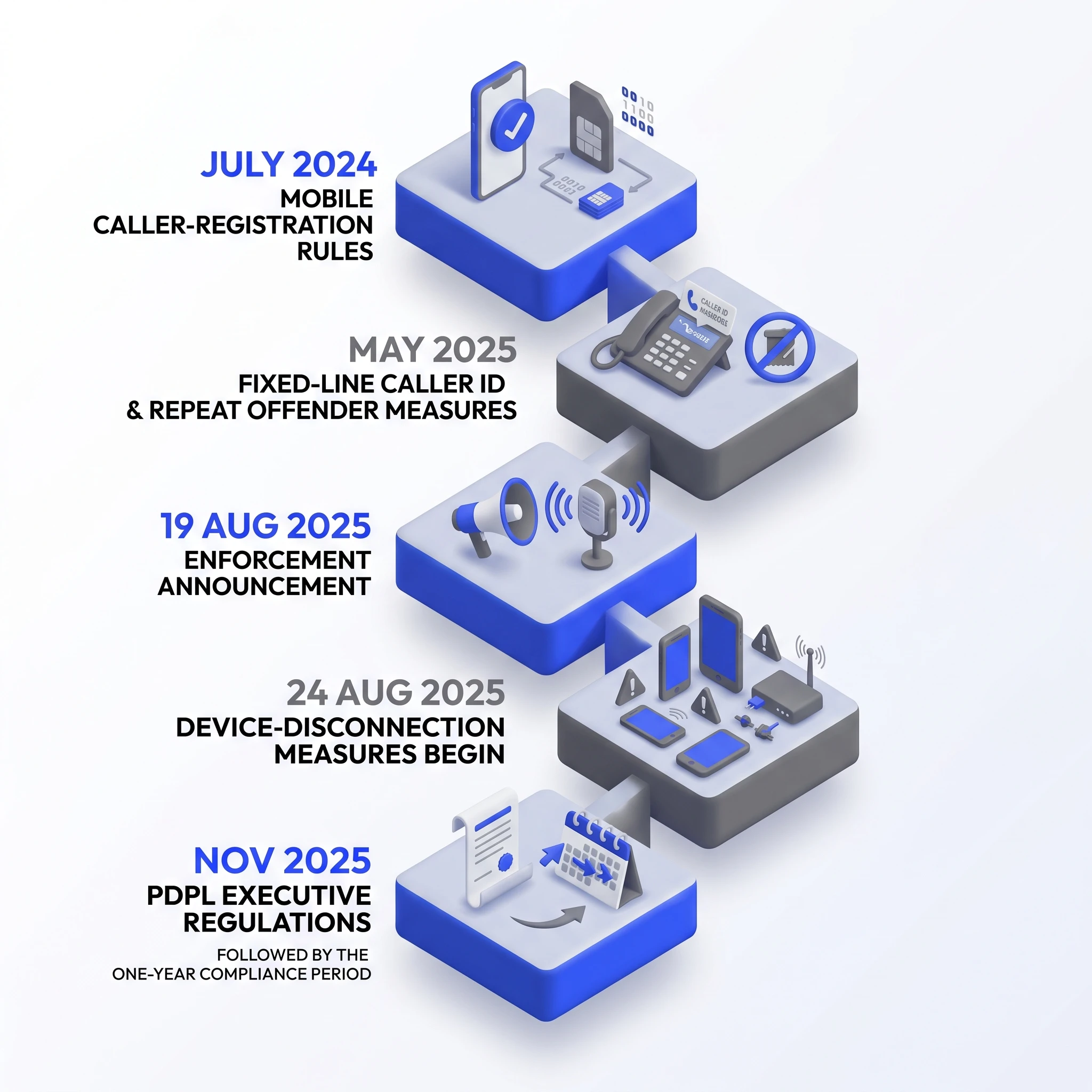
The NTRA announced the stronger enforcement measures on 19 August 2025, with implementation beginning on 24 August 2025. These measures are therefore already part of the operating environment for promotional calling in Egypt, rather than an upcoming deadline.
Their significance has increased in 2026 because the Executive Regulations under Egypt’s Personal Data Protection Law, issued in November 2025, added more detailed rules for direct electronic marketing, including consent, record-keeping and licensing requirements. Organizations subject to the law are also approaching the end of the one-year reconciliation period, commonly calculated as 1 November 2026.
The August 2025 notice said the NTRA would begin stronger technical and regulatory action against mobile devices detected making nuisance promotional calls in breach of its rules. The stated objective was to respond to continuing complaints and protect users’ rights and privacy.
At the time of the announcement, the NTRA said approximately one million lines had joined the registered promotional-call service since its launch the previous year. Registered calls could display the name and number of the calling entity, or an advance “NTRA Alert,” allowing recipients to decide whether to answer.
The regulator urged both users and companies making promotional calls through mobile or fixed networks to contact their telecommunications providers, subscribe to the service, and register their numbers and type of promotional activity.
The August measure was not the beginning of the framework. It strengthened a system developed in stages:
The official materials use broad expressions such as “promotional,” “marketing” and “commercial” calls. The NTRA’s consumer guidance describes marketing communications as calls from a subscriber’s telecommunications provider promoting a service, product, package or offer, as well as calls from commercial businesses promoting goods or services. Real-estate and tourism marketing are given as examples.
The practical scope therefore goes beyond large call-centre campaigns. It can include:
The published NTRA materials do not create an exemption for small campaigns, sole callers, existing customers or calls made from an employee’s personal line. A service call, delivery coordination or response to a customer request may have a different purpose, but adding a sales pitch can move the interaction into promotional territory. Businesses should classify call purposes before deciding which controls apply.
At a minimum, the NTRA materials require the caller to contact the relevant telecommunications provider, register its information, register the numbers used and identify the type of promotional activity. The promotional-call service must then be activated so that recipients see the calling entity’s identity or receive the required alert.
The central NTRA notices do not publish a complete, standardized document checklist for every operator. They also do not give detailed registration instructions for fixed-line campaigns. A business should therefore obtain the current process directly from each provider and retain written confirmation for every number used.
A defensible internal register should include:
Do not assume that registering a few main numbers covers agents calling from personal SIMs, replacement numbers, overflow lines or a vendor’s separate dialler estate.
The NTRA system is designed to make the nature and source of a call visible. Depending on the service and network, a recipient may see the entity’s name and number or an advance “NTRA Alert” identifying the call as promotional. The NTRA has also described fixed-line caller identification and enhanced labels for categories such as delivery personnel, journalists and charity workers.
That transparency is useful, but it addresses only one part of compliance. A displayed business name does not prove that the recipient consented, that the phone number was collected lawfully, or that the campaign may continue after an objection.
| Layer | What it controls | Minimum operational action | If ignored |
|---|---|---|---|
| NTRA caller registration | Which numbers may be used and how the caller or promotional nature is identified. | Register each mobile or fixed number and its activity with the relevant provider; activate and test caller identification. | Warnings, device restrictions, repeat-offender measures and possible legal referral. |
| PDPL and Executive Regulations | Lawful use of contact data, explicit consent, transparency, withdrawal, records and direct-marketing authorization. | Prove consent and source, identify the caller and purpose, honor withdrawal, retain required records and assess licensing. | Regulatory action and fines, including the Article 43 electronic-marketing range. |
| Telecom and cybercrime offences | Intentional harassment or disturbance and specified non-consensual uses of personal data or electronic communications. | Prevent nuisance patterns, unlawful lists and attempts to evade registration through replacement lines. | Potential criminal investigation, imprisonment and fines depending on the facts. |
| Vendor governance | How outsourced agents, diallers, lead sources and suppression lists operate in practice. | Set contractual controls, verify evidence, restrict approved routes and audit actual campaigns. | Shared operational failure, repeat complaints and inability to prove compliance. |
Registration and consent are cumulative controls: satisfying one does not satisfy the other.
The August 2025 announcement focuses on disconnecting mobile devices detected making nuisance promotional calls in breach of the NTRA framework. The regulator’s more detailed May 2025 Arabic notice describes a graduated response:
The measures apply at device and subscriber level to prevent callers from continuing through replacement lines.
However, the NTRA’s published notices do not disclose the full detection methodology, complaint threshold, evidentiary process or technical identifier used to implement a device block. They do not expressly say that an IMEI is the identifier, and they do not comprehensively explain whether a SIM is suspended in every case. It would therefore be inaccurate to describe the measure as a confirmed “IMEI ban” or to invent a fixed number-of-calls threshold beyond the NTRA’s published repeat-use statement.
The May 2025 notice says a device may be reactivated after the offending line is registered. The published August announcement does not set out a formal appeal route, required evidence, review period or service-level target for a disputed block.
An affected organization should immediately:
Registering the line may support reactivation after an initial action. It should not be treated as a guaranteed cure for repeated misuse or as a substitute for challenging an incorrect block through the provider and regulator.
The NTRA’s August notice expressly referred to Article 76 of Telecommunications Regulation Law No. 10 of 2003 and Article 25 of Anti-Cyber and Information Technology Crimes Law No. 175 of 2018.
Article 76 provides for imprisonment and a fine of EGP 500 to EGP 20,000, or either penalty, for conduct including intentionally disturbing or harassing another person through misuse of telecommunications equipment.
Article 25 of Law No. 175/2018 provides for imprisonment of at least six months and a fine of EGP 50,000 to EGP 100,000, or either penalty, for specified privacy and unlawful-content offences. Its wording includes sending a large volume of electronic messages to a person without consent and providing personal data to an electronic system or website to promote goods or services without consent.
Whether either criminal provision applies to a specific company, manager, employee or campaign depends on the facts and the legal characterization of the conduct. The NTRA notice should not be read as saying that every registration error automatically results in the maximum criminal penalty.
There is also a separate data-protection exposure. Article 43 of Personal Data Protection Law No. 151 of 2020 provides for a fine of EGP 200,000 to EGP 2 million for violating the direct electronic marketing requirements in Articles 17 and 18. That PDPL penalty was not the basis cited in the August 2025 NTRA announcement, but it is relevant to the same campaign when personal data and direct marketing are involved.
Egypt’s Personal Data Protection Law prohibits direct electronic marketing unless its conditions are met. Article 17 requires, among other things:
Article 18 requires a defined marketing purpose, protection against disclosure of the person’s contact details, and electronic records of consent or non-objection and later changes for three years from the last communication.
The Executive Regulations issued under Ministerial Decision No. 816 of 2025 make the operational position clearer. Their direct-marketing provisions expressly refer to phone calls as well as messages, social media and email. They require explicit consent, identification of the caller and marketing purpose at the start of the communication, an effective refusal or withdrawal route, erasure when consent is withdrawn or the retention period or purpose ends, and electronic evidence of consent and related requests.
The Regulations also introduce a specific licence or permit for direct electronic marketing, with different categories for marketing an organization’s own goods or services and marketing on behalf of another entity. Because the licensing framework, institutional procedures and the law’s one-year reconciliation period can affect implementation timing, organizations should confirm their exact licensing path and deadline with the Personal Data Protection Center and qualified Egyptian counsel.
The safe operational rule is therefore:
Use a registered promotional number only for recipients whose marketing permission and data source can be demonstrated.
Buying a list, receiving a referral, finding a phone number online or having an existing commercial relationship does not by itself prove the explicit consent contemplated by the Executive Regulations.
The NTRA materials address both users and companies. The control should follow the purpose of the call, not the job title of the person holding the phone.
If an employee, broker, salesperson or founder uses an individual line to make calls for a business campaign, describing the line as “personal” does not turn the calls into personal activity. The business should prevent staff from conducting promotional outreach through ordinary SIMs, reimburse only approved lines, and enforce the rule through dialler permissions, mobile-device controls and disciplinary procedures.
Individual agents also need training. They should know how to identify the business and purpose, handle a withdrawal, record the outcome accurately, avoid copying numbers into personal address books and stop a call when the recipient objects.
An outsourced call centre can create at least three different roles: the brand deciding why and whom to call, the provider operating the dialler and handling the data, and the marketing intermediary initiating the communication. Contracts should allocate tasks, but a contract cannot erase statutory duties.
The PDPL Executive Regulations place direct obligations on a marketing intermediary. The intermediary must verify that the controller or processor obtained consent for the declared purpose and retain the source of the contact data, including the relevant consent. If it cannot do so, it must stop using that data for electronic marketing.
| Participant | Core responsibility | Evidence to retain | Key failure to prevent |
|---|---|---|---|
| Brand or campaign owner | Define the purpose and audience, establish lawful data use and consent, approve scripts and routes, and oversee vendors. | Consent provenance, campaign approval, suppression records, provider confirmations and vendor audits. | Assuming the call centre’s warranty transfers all responsibility. |
| In-house sales team | Use approved registered numbers, identify the business and purpose, and record objections accurately. | Agent assignment, training, number authorization, call outcomes and withdrawal actions. | Using personal SIMs or copying leads into personal devices. |
| Outsourced call centre or intermediary | Verify consent and its source, operate only approved routes, follow the declared purpose and stop using unsupported data. | Source and consent records, dialler logs, scripts, agent access, deletion logs and complaint files. | Calling a supplied list without verifying consent provenance. |
| Telecommunications provider | Register the subscriber, number and activity; activate caller identification; and apply network controls. | Application, activation confirmation, registered label, test results and restriction correspondence. | Treating an ordinary business or personal line as registered for promotion. |
A proper call-centre agreement should cover approved numbers, caller registration, permitted purposes, consent evidence, scripts, suppression lists, call recording, access controls, sub-processors, cross-border transfers, complaint escalation, audit rights, security incidents, deletion and return of data. The brand should test actual operations rather than relying only on a contractual warranty.
The NTRA announcement does not explain how its promotional-number registration service applies to a call centre outside Egypt using a foreign carrier, foreign number or cloud telephony route. It would be unsafe to assume either that the NTRA registration mechanism applies in exactly the same way or that overseas origination removes the campaign from Egyptian requirements.
Separate questions remain:
Before an overseas campaign goes live, the brand should obtain a written routing position from the relevant Egyptian telecommunications provider and a legal assessment of the PDPL, licensing and international-transfer implications.
The NTRA says recipients can report anonymous promotional calls or calls received without the required warning through telecommunications providers’ call centres, the NTRA hotline at 155, the My NTRA application or the dedicated reporting portal at fraud.tra.gov.eg.
A business may therefore learn about a problem first from its operator or from a device restriction rather than from its own customer-service team. Internal complaint handling should connect marketing, privacy, legal, telecommunications and vendor-management functions.
For every complaint, record:
One suppression list should apply across internal teams, agencies, replacement diallers and future campaigns. A withdrawn number should not reappear because another vendor imports an older copy of the lead list.
Egypt’s framework is designed to remove anonymity from promotional calling and make repeated use of ordinary lines increasingly difficult. The strongest compliance model combines network registration with lawful lead acquisition, explicit marketing consent, visible caller identity, easy withdrawal, centralized suppression and evidence that survives outsourcing.
The mistake to avoid is treating registration as a complete marketing licence. A registered number can still be used for a non-compliant campaign, while a consented campaign can still breach the NTRA framework if agents call from unregistered lines.
Kooch helps organizations map cross-border marketing data, review operational controls and vendor responsibilities, and build evidence-based privacy and compliance workflows. For Egypt-specific legal interpretation, licensing or enforcement representation, we recommend coordinating the implementation with qualified Egyptian counsel.
Related Kooch services: GDPR and KVKK gap analysis and ongoing compliance operations support.