

Yes. You can start ISO/IEC 27001 readiness with an information security management system (ISMS) scoped to the delivery of one SaaS product. Start with the service the customer is buying. Include the work your team does to build, operate and support it, and trace the shared systems and suppliers that work relies on.
Clause 4.3 requires you to document the boundaries and applicability of your ISMS. In setting them, consider the internal and external issues identified under clause 4.1, the relevant interested-party requirements identified under clause 4.2, and the interfaces and dependencies between your activities and those performed by other organizations.
ParcelQueue is a fictional SaaS product for managing shipment exceptions. Its standard subscription includes a hosted dashboard and API, backups and business-hours support. The same company also sells a dedicated deployment of ParcelQueue with a separate cloud account and release process. A prospective buyer asks whether the standard subscription would be covered by the planned certification.
Before writing the scope statement, map four things:
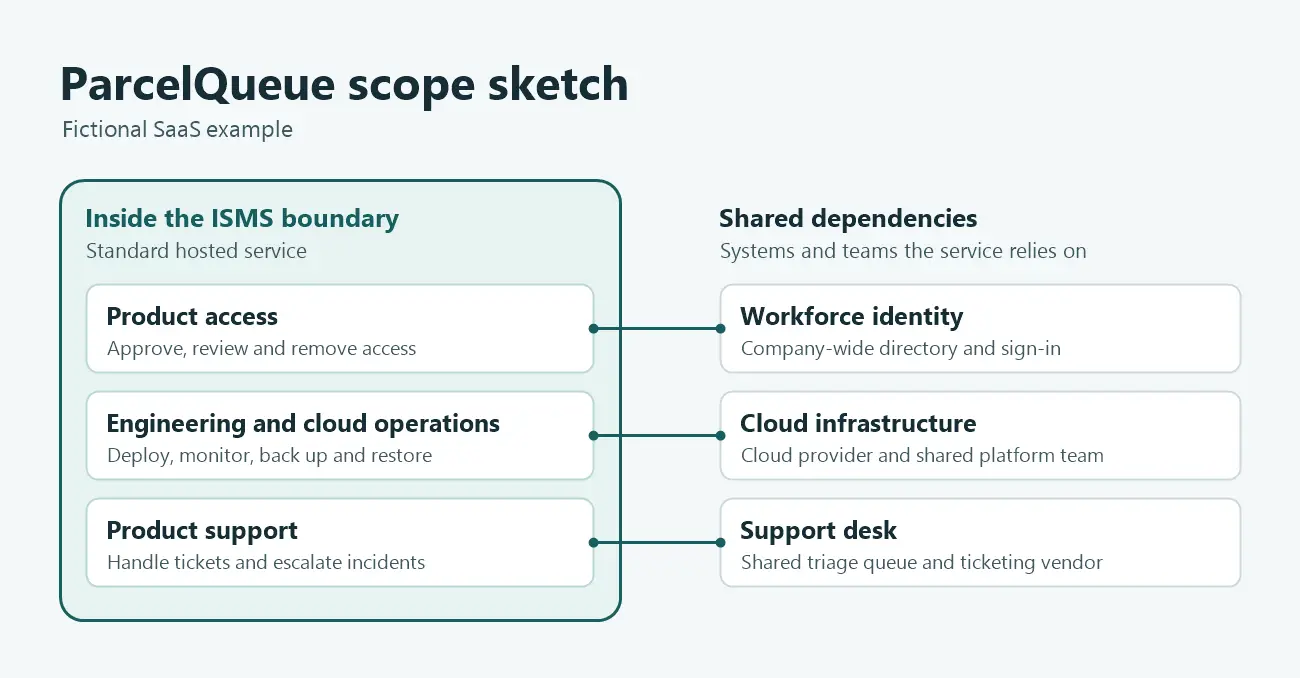
A shared system can be a dependency while the work performed through it is an in-scope function. For instance, the ticketing vendor operates the tool. Routing and handling ParcelQueue cases, reviewing their attachments and escalating suspected incidents belong in scope wherever those tasks sit. Record which steps the shared desk handles and which the product team handles.
For each boundary decision, write down the activity, who performs it, why it sits where it does, the risk at the handoff and who can produce evidence. For example, record the dedicated deployment as outside the initial scope because the buyer ordered the standard service and the dedicated environment has its own account and release process. Verify that separation and assess any shared access or tooling that could still affect the standard service.
Put the draft scope beside the order form, security addendum and procurement question. Check the legal entity, deployment and activities the buyer expects to see. If the buyer asks for “ParcelQueue and support,” confirm whether that means the standard subscription alone or includes a dedicated instance. Ask procurement to confirm ambiguous wording before you base a readiness quote on it. When responding before certification, describe the scope as proposed and state your current certification status. Once issued, use the scope on the certificate to describe what the certified ISMS covers.
Version A — Standard hosted service. “The ISMS covers the development, operation and support of the ParcelQueue standard hosted service provided by ParcelQueue Software Ltd.” Use this option if the buyer confirms standard hosting is sufficient and the team can show how shared access, cloud and support responsibilities work for that deployment.
Version B — Standard and dedicated deployments. “The ISMS covers the development, operation and support of the ParcelQueue standard hosted service and dedicated deployments provided by ParcelQueue Software Ltd.” Price the added work to map dedicated accounts and release paths and gather evidence for their access, backups and recovery. Consider this option if the buyer requires dedicated hosting to be covered or leadership wants both deployment models in the initial scope.
Ask leadership to approve a version and name the owners who will supply evidence before requesting a quote. These boundaries are illustrative. Ask your independent certification body to review the proposed certificate wording and any exclusions you expect to rely on. The body determines certification after assessment.
Sketch one service boundary and annotate three shared dependencies. For each, write down who runs it, what crosses the boundary and who can show that the handoff works. Bring the sketch and the buyer’s exact scope question to a Kooch ISO/IEC 27001 readiness scoping call.